Priscilla
Acts of the ApostlesPriscilla’s significance in Acts lies not in a narrated personal biography but in the work she shares: she makes a living alongside Aquila and Paul, participates in the mission, and joins Aquila in teaching Apollos. The commentary reads these details together as a model of the Realm’s mutual partnership between women and men, and as a challenge to church structures that restrict women’s leadership.
Identity and Setting
Priscilla appears in the account of Paul’s arrival in Corinth, where he meets her and Aquila. They are Jewish refugees who had left Rome after Emperor Claudius expelled the Jewish population, probably in 49 CE. Their story therefore places Priscilla within the broader experience of persecution and displacement, rather than presenting the couple simply as settled local hosts.
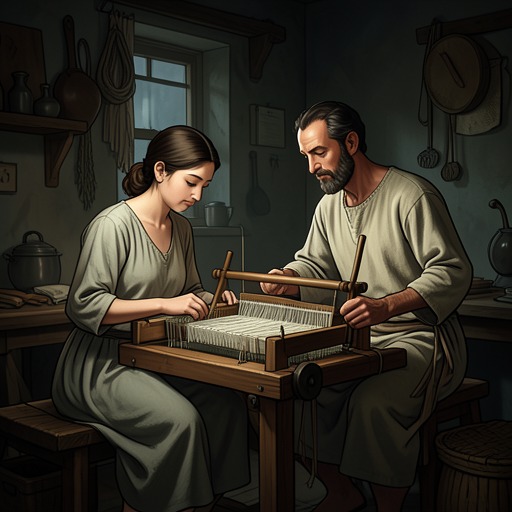
Priscilla, Aquila, and Paul are described as tentmakers. Since tents were often made of leather or heavy cloth, the work involved skills associated with leatherworking or weaving. It connected them to the marketplace, where people could meet and discuss ideas, and helped explain how Paul financed his mission while also bearing witness there. Priscilla’s presence in this working partnership situates her within the practical and economic life of the mission, not at its margins.
Work and Missionary Networks
The couple’s connection with Paul links their household and trade to a wider network of travel and witness. In Corinth, Priscilla and Aquila meet the missionary after his departure from Athens; later, the account brings them into the work of teaching Apollos. Their role illustrates how the movement’s reach depended not only on public preaching but also on companions, shared work, and instruction across personal connections.
Priscilla and Aquila’s labor also illuminates the material circumstances of ministry. Their trade provided a means of support, while the marketplace offered a setting for contact and discussion. The commentary notes that the expression “tent maker ministry” later became a way to describe ministers who hold work outside the church to support their ministries. That later usage should not be mistaken for Luke’s original concern with modern church staffing: the account’s concrete point is the relationship between livelihood and mission.
Teaching Apollos
Acts presents Priscilla and Aquila as joint teachers of Apollos, an eloquent and scripturally learned Jewish person from Alexandria. Apollos is himself a teacher, yet the account regards his experience as incomplete because he has received only John’s baptism. In the commentary’s account of entry into the community of the Realm, repentance, baptism in the name of Jesus, and receiving the Spirit belong together. Priscilla’s participation in instructing a gifted male teacher therefore marks her as an active bearer of theological knowledge.
The instruction also adds a significant dimension to Priscilla’s partnership with Aquila. They share responsibility for teaching rather than appearing as a leader and a silent assistant. The commentary cautions against calling them the first clergy couple, an anachronistic label, while emphasizing that their shared teaching models an egalitarian form of leadership. Apollos’s stature makes the scene especially telling: being an established teacher does not make a person finished in discipleship, and the couple’s teaching contributes to his further formation.
Gender, Authority, and the Realm
The commentary connects Priscilla’s teaching with the earlier story of Mary and Martha in Luke. It reads Mary’s place as a learner at Jesus’ feet as recognition of her as a full disciple, taught as the apostles were; in Acts, Priscilla’s acknowledged role as a teacher carries that impulse further. Across these scenes, women’s participation in learning and teaching signals an unfinished restoration of partnership between women and men in the Realm.
This interpretation makes Priscilla’s narrative importance institutional as well as personal. Her example bears on congregations where women encounter limits to positions of authority, including what the commentary calls a stained-glass ceiling. It argues for shared leadership not only among clergy but throughout church life, and asks how communities might move beyond partial inclusion toward mutually supportive partnership. Priscilla is thus a concise but consequential figure: her work, teaching, and collaboration embody a form of leadership in which women are recognized as contributors to the community’s mission and its understanding.